
By Victor Kuarsingh
I recall way back in the mid-90s, this new phenomenon called the “Internet”. Working in a Computer Store while in school, it was the perfect place to watch the fledgling Internet landscape grow from a consumer’s perspective. Sure I had my model years priory surfing BBS sites – but this was different.
Strolling the aisles in the store, I saw this interesting display of software packages frontingInternet access providers like Delphi and Microsoft Network as well as early browsers such as Mosaic and Netscape Navigator.,
Dial-up was the primary method of access. With the right modem, speeds progressed from 14.4 Kbps to 28.8 Kbps and 33.6 Kbps, eventually reaching 56 Kbps—after a brief protocol war between U.S. Robotics’ x2 and Lucent/Rockwell’s K56flex was settled by the universal V.90 standard.
If you were a business or had money to burn, ISDN was an option, unleashing 64 Kbps or dual-channel 128 Kbps. For large enterprises with real budgets, T1 lines providing a blazing 1.544 Mbps were the gold standard. As we moved past the 1990s into the 2000s, consumer speeds exploded with the arrival of telecom Digital Subscriber Line (DSL) offerings and cable internet, which matured into high-speed DOCSIS standards by the mid-2000s.
Moving through the 2000s and 2010s, we have seen continuous innovation in internet infrastructure to support an explosion of online services, digital experiences, and remote work built on this flourishing fabric. Today, it’s hard to imagine a world where we can’t work from home, attend classes, check social media with the tap of a screen, order food, book trips, video call loved ones, or stream our favorite shows.
Now, here is the kicker: this was and is my experience living in North America, a reality far removed from what many in the world experience today.
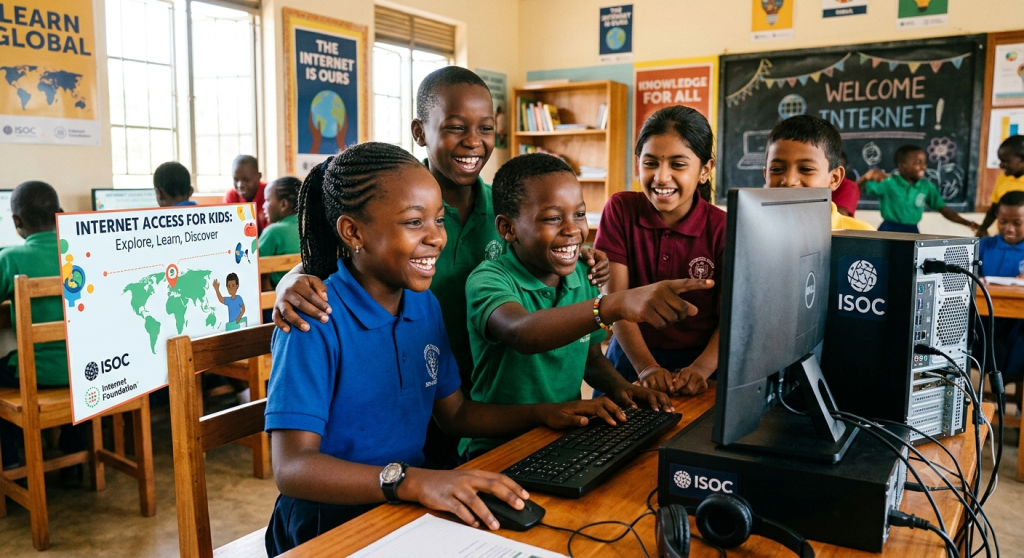
However, while many of us enjoy this as our daily normal, a massive portion of the global population does not. What we take for granted as ‘the Internet’ is often unreliable, severely restricted, or entirely unavailable elsewhere. Millions of eager, talented young people are limited in their educational pursuits, isolated from global news, and cut off from the rest of the world—not by choice, but by a lack of basic infrastructure.
This is why organizations like the Internet Society (ISOC) and the Internet Society Foundation are so crucial. For years, these non-profits have worked tirelessly to close the digital divide. Through hands-on programs that expand infrastructure, foster local tech communities, and champion open access, these heroes work to truly democratize the internet for everyone.
Seeing the face of a young student connecting to world-class educational resources for the first time, or a family reuniting across continents, or a remote village accessing lifesaving telemedicine warms the heart. This is the vital work that the Internet Society and Internet Society Foundation continue to drive forward. Powered by dedicated staff, passionate global chapters, and countless volunteers, they are changing lives every single day.
I normally don’t ask others to Donate, but for those who find it in their heart to support this critical work, the Internet Society would most definitely appreciate the opportunity to pay that forward. Just look at the Impact Stories.


